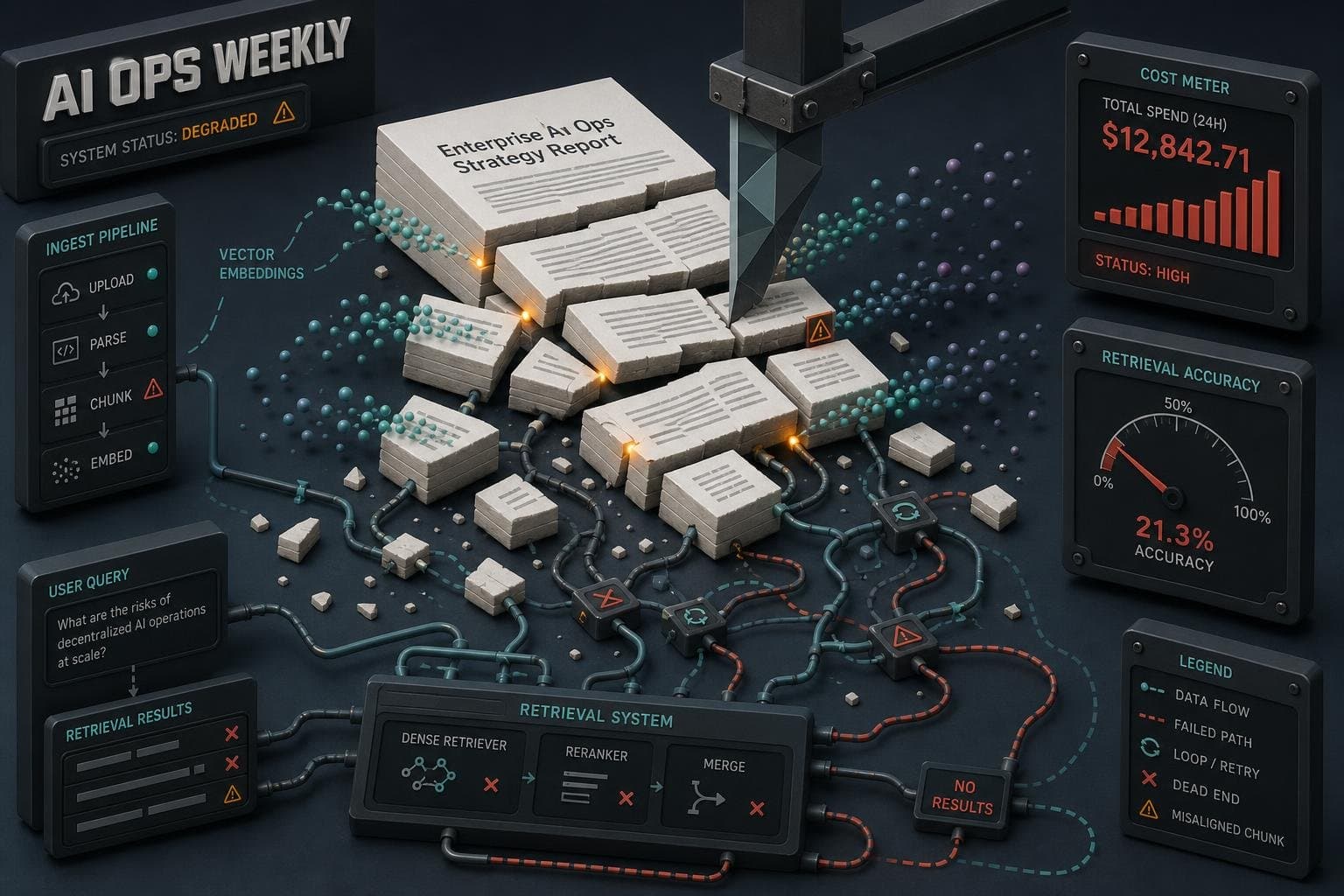

A team runs 500,000 queries a month. Their dashboards look fine. Then a customer audit reveals that 30% of answers were fabricated from fragments of the wrong document sections. The retrieval wasn't broken — it was returning something. Just not the right something.
That quote, reported by Synclovis, is the most honest description of how chunking failures actually present in production. Not as crashes. As quiet, compounding wrongness.
According to Synclovis's analysis across production deployments, 40% of RAG failures trace back to chunking strategy alone, and context window bloat from poor chunking drives 3–8× cost inflation. Those numbers don't show up in your error logs. They show up in your token bill and your user churn.
The Fundamental Tradeoff Nobody Warns You About
Chunking has two failure modes, and they pull in opposite directions.
Chunks that are too large dilute the embedding. When a single chunk contains authentication setup, rate limit documentation, and error code definitions, the resulting vector becomes an average of all three topics. As the Medium analysis of chunking strategies explains, a query about rate limits retrieves a chunk that technically contains the answer — buried under irrelevant context that degrades both retrieval precision and the model's ability to use what it found.
Chunks that are too small fragment meaning. Split a refund policy sentence-by-sentence and you get: "The refund policy applies to enterprise customers." / "Refunds are only valid within 30 days." Retrieve only the second sentence and the model loses the enterprise-customer constraint entirely. The result: incomplete or incorrect answers that look complete.
The naive fix — fixed-size splitting at 500 tokens — solves neither problem. It just picks a point on the tradeoff curve without thinking about where your content actually breaks.
What Actually Works: Matching Strategy to Content Structure
The production answer isn't a single chunking method. It's recognizing that different content types need different boundaries.
Semantic chunking groups text by meaning rather than token count. A semantic chunker identifies natural topic boundaries — a glossary entry might be two sentences, while an authentication flow explanation needs to stay intact. The chunks vary in size, but they vary correctly. The n8n team's analysis frames this as treating chunking as a design decision rather than a preprocessing step, which is the right mental model.
The practical tradeoff: semantic chunking is slower to build and requires more upfront work to tune. Fixed-size chunking is fast and predictable. Most teams start with fixed-size and discover its limits in production; the smarter move is to audit your content structure before you index anything.
The production failure table from n1n.ai's 2026 RAG architecture guide is worth keeping nearby. "Chunking Mismatch" — where the answer spans a chunk boundary — produces "'Not in context' errors despite the document containing the answer." That's the symptom. Teams spend weeks debugging embedding models and vector search when the problem was decided at index time.
The Context Window Trap Makes This Worse
Here's where chunking intersects with a separate problem that's gotten worse in 2026: the illusion of large context windows.
Thirteen models now ship context windows of 1 million tokens or more. Elvex's August 2026 analysis makes the engineering reality clear: effective capacity is roughly 60–70% of the advertised maximum, and the drop-off isn't gradual. Models hold performance until hitting a threshold, then fall sharply. Chroma tested 18 models on long-context tasks — every single one degraded as context grew. The most counterintuitive finding: models performed better on shuffled text than coherent text, because coherent text creates positional patterns that trigger recency bias, causing the model to over-weight content near the end of the input.
The implication for chunking: stuffing more context into the window because you technically can is actively harmful. A 1M-token window doesn't mean you should retrieve 20 chunks instead of 5. It means you have more rope to hang yourself with. Good chunking is what keeps retrieval targeted enough that you're not relying on the model to find signal in a haystack you assembled.
The Operational Fix
The DevOps.com incident diagnosis retrospective from August 24 is instructive here: the team building a RAG system over postmortems and runbooks found that "the boring parts mattered more than we expected." Their system hit 87.3% root-cause identification accuracy — but only after treating retrieval architecture as the primary engineering problem, not the model selection.
The practical checklist for any team hitting retrieval quality issues:
- Audit your chunk boundaries before touching your embedding model. Print 20 retrieved chunks for real user queries. Are the boundaries in sensible places? Are answers split across chunks?
- Add overlap for fixed-size chunking. A 10–15% token overlap between adjacent chunks catches most boundary splits without the complexity of semantic chunking.
- Match chunk size to query type. Short factual queries need small, precise chunks. Synthesis queries need larger chunks with more surrounding context.
- Measure retrieval quality separately from generation quality. Synclovis's framing is direct: "If you don't have a retrieval evaluation suite, you don't have a RAG system. You have a retrieval lottery."
The context window problem and the chunking problem look like separate issues. They're the same issue: you're deciding how much information to hand the model and in what shape. Get that decision wrong at index time, and no amount of reranking or prompt engineering fixes it downstream.


