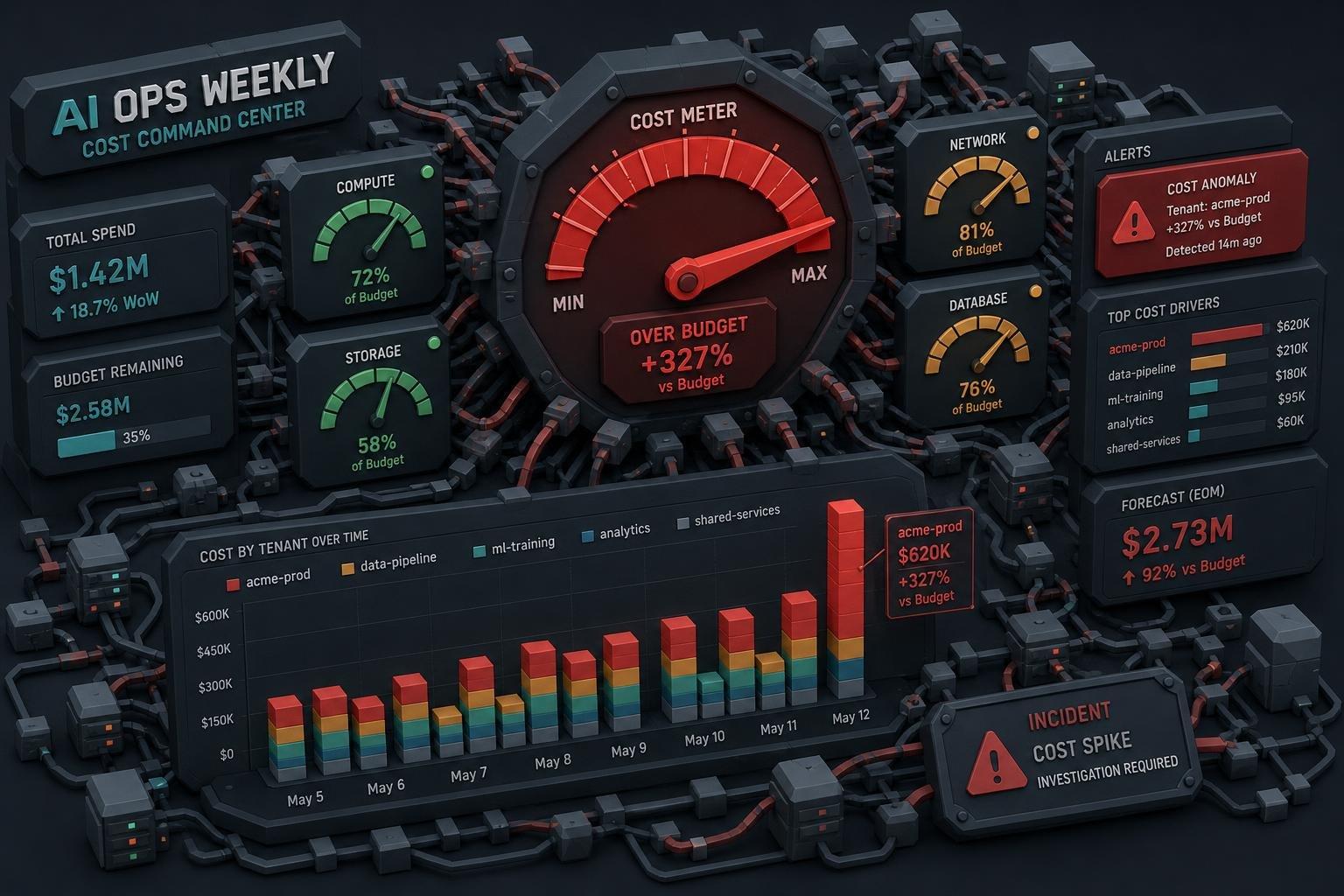

Here's a number that looks fine and means almost nothing: "our average customer costs $2.40 a month in LLM spend." Run that math yourself — a 2,000-input, 400-output token chat reply on a modern model costs around $0.008, times 300 requests a month, and you land right at $2.40 per customer, per one practitioner's breakdown. Clean number. Useless number. Because in most SaaS products, a small slice of accounts generates most of the volume, and the average buries exactly the information you need to protect your margin.
Averages Are a Finance Problem Disguised as a Math Problem
The same source runs the distribution: if 10% of customers generate half of all requests, that minority isn't paying $2.40 worth of inference — on an agentic product doing multi-step tool calls, they can run double the cost of the flat-rate plan they're actually on, turning a $99/month account into a $200/month cost center per the same analysis. The digitalapplied.com team, which does cost attribution work across agency engagements, calls this out as one of the three patterns behind nearly every production cost incident they see: reporting cost-per-customer as an average "papers over a long-tail where 3% of tenants consume 60% of tokens" (Digital Applied). If your pricing team is optimizing against the mean, they're optimizing against a number nobody's actual bill looks like.
The fix isn't a better average. It's percentile reporting at the tenant level — p50, p90, p99 cost per customer, tracked the same way you'd track latency. If you only have one number, you have no idea whether you have a pricing problem or a single runaway account.
Attribution Has to Happen at the Request, Not at the Invoice
The provider invoice is where cost visibility goes to die. OpenAI and Anthropic will tell you what a model cost in aggregate; they will not tell you which customer, feature, or agent step caused it, because "that context only exists inside your application," as the team at Respan puts it in their cost-tracking writeup (Respan). Digital Applied's advice is blunter: instrument on day one, because "retroactive tagging from logs always misses edge cases and under-reports long agentic traces" (Digital Applied). I've watched teams try to reconstruct tenant-level cost by joining CloudWatch logs to a customer table a quarter after the fact. It's archaeology, not engineering, and by the time you've dug up the answer the pricing conversation with the offending customer has already gone stale.
The practical version of this is tagging every call at creation time with tenant ID, feature, model, and environment — a request header if you're running a proxy, a log field if you're not — per the tagging pattern described in the PromptUnit cost-tracking guide (DEV Community). None of this is novel engineering. It's the same instrumentation discipline you already apply to request tracing. The difference is that nobody treats it as mandatory until the first invoice doubles.
Cache Accounting Will Lie to You Just as Confidently as the Average
Even with per-tenant tagging in place, a naive "total tokens times list price" calculation can over-report spend by 40% or more on workloads that lean on prompt caching, because cached reads, cache writes, and batch tokens all price differently from list rate (Digital Applied). Cache discounts aren't trivial either — cached input can run as low as 2.5% of list price on some current models (CloudZero) — which means a tracker with a stale price table or a flat per-token assumption will misprice every cache-heavy tenant in your system, usually in the direction of overstating their cost.
And the billing surface keeps shifting underneath you. OpenAI moved new ChatGPT Enterprise agreements to pure token billing in August 2026 (CloudZero), and AI-native software spend has been climbing fast enough that finance teams are starting to treat it as its own line item rather than a rounding error — one vendor's billing data shows AI-native spend in the UK running 25% higher over a recent three-month stretch than the quarter before it (Cledara). A cost model that was accurate in Q2 is not guaranteed to still be accurate in Q4.
What to Actually Build This Quarter
Skip the provider dashboard as your source of truth — it shows spend by model and API key, not by the tenant or feature that caused it. Tag every call at request time. Report cost distribution by percentile, not average, per tenant. And put a daily spend cap on the account level before you build the dashboard, because a dashboard that lags by a day won't stop a runaway agent loop from eating a month's margin in an afternoon.