



A software engineer watched his team's LLM bill triple in three weeks with no pricing change and no traffic spike. When he finally pulled the logs, the cause wasn't volume — it was repetition. Thousands of near-identical support questions, phrased ten different ways, each one hitting the model fresh and getting billed fresh, because "What's your refund policy?" and "How do refunds work?" look nothing alike to a string-matching cache (Erwin Hermanto, Medium).
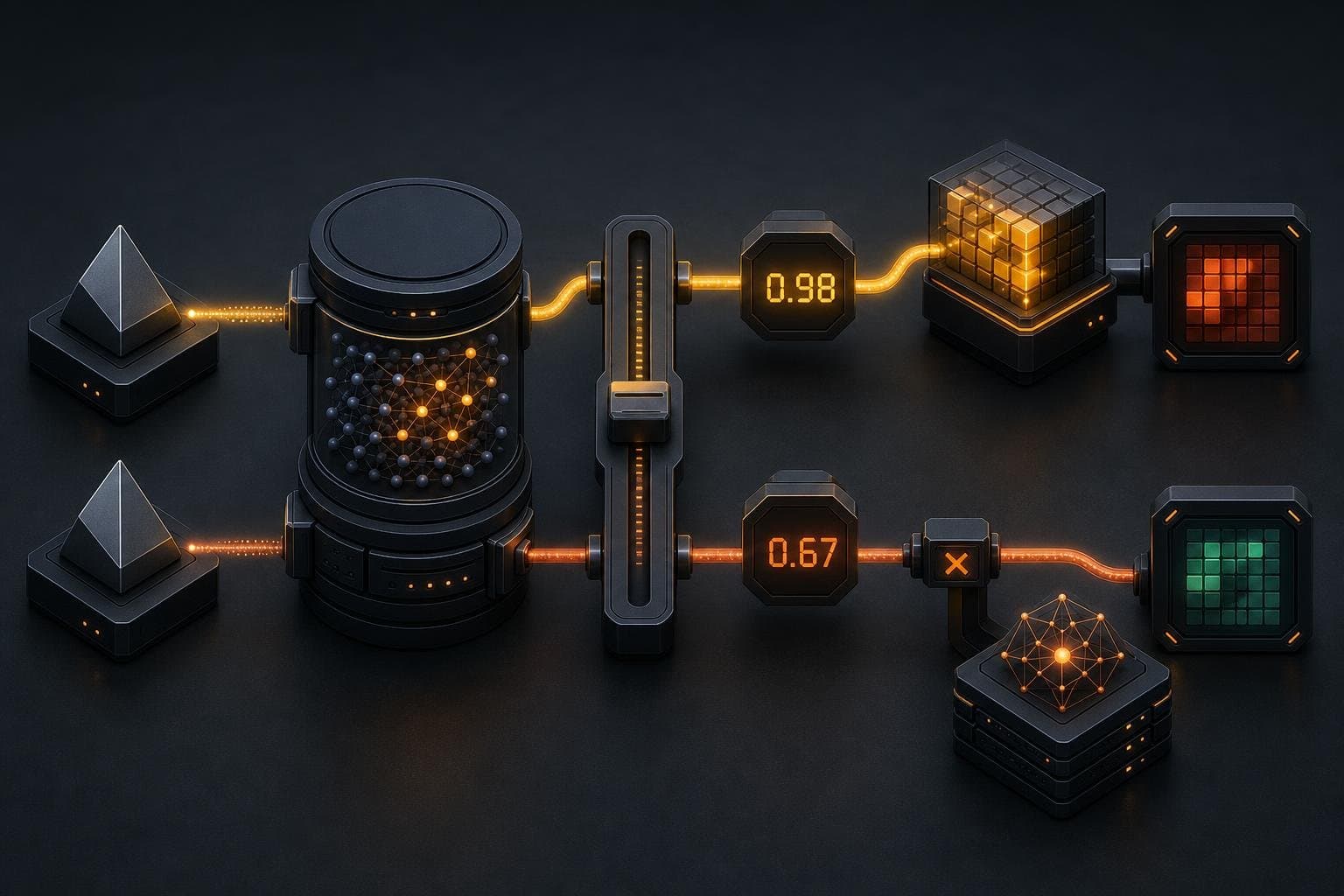
That's the pitch for semantic caching: embed the incoming prompt, compare it against stored query vectors, and if the cosine similarity clears a threshold, skip the model call entirely and serve the old answer (Arize AI). It's a reasonable bet. It's also a different kind of cache than most backend engineers have built before, and the failure modes aren't the ones you're used to.
This isn't the cache you shipped last year
A traditional cache is deterministic — same key, same value, every time. Semantic caching is probabilistic. The system is guessing that two differently-worded questions mean the same thing, and that guess is tunable, which means it's also wrong sometimes (ByteByteGo). That's worth separating from prompt caching, the feature Anthropic and OpenAI ship natively, which reuses an identical prompt prefix so the model skips re-processing tokens it's already seen — but still generates a fresh answer every time. Semantic caching skips generation altogether and hands back something written for a different, merely similar, question (ByteByteGo). One saves compute on known input. The other bets that two inputs are close enough to share an output. Those are not the same risk profile, and conflating them is how teams end up surprised.
The savings math is smaller than the vendor slide
Redis markets its LangCache product with a headline of saving up to 90% on API costs. A closer look at Redis's own documentation shows the service was still in public preview as of early October 2026, with no published price, and Redis's own savings formula — hit rate multiplied by output-token cost — puts real savings below the advertised hit rate, not at it (North Denver Tribune). That tracks with what the mechanics actually deliver: a cache hit avoids output-token generation, which is usually the expensive part, but you still pay for the embedding call and the vector lookup on every single request, hit or miss (TensorMesh). If your input prompts are already short and your outputs are long, that trade is good. If it's the other way around, you're paying infrastructure overhead to save pennies.
This matters more in a 2026 pricing environment where input-token costs between model tiers already differ by up to 100x and reasoning models burn extra "thinking" tokens billed as output — the kind of environment where architecture decisions compound fast and routing to the wrong tier for a week shows up on the invoice (Monterail). Semantic caching is one lever in that system, not a silver bullet layered on top of it.
A wrong hit costs more than a miss ever did
The threshold is a quality control, not just a cost control, and the failure cases live in the gap between "similar enough to a human" and "similar enough to serve." Consecutive turns in a multi-turn conversation can score around 0.99 similarity to each other while meaning something completely different in context — which means a cache tuned for single-shot Q&A will confidently replay stale answers into agent workflows it was never tested against (North Denver Tribune). And nobody's watching for it: hit-rate dashboards shipped by cache products report operations — hits, misses, evictions — not quality. They won't tell you that half your "hits" were borderline matches sitting just above a shaky threshold, or that the same question got stored under three different keys because nobody normalized the prompt first (DEV Community, haoli).
That's the gap worth closing before you ship this. A semantic cache needs the same operational discipline as any other probabilistic system in your stack: log similarity scores alongside hits, track near-misses separately from clean hits, and treat a wrong answer served confidently as a worse outcome than a cache miss that cost you a model call. Measure hit quality, not hit rate (Arize AI) — the number on the dashboard was never the thing you actually needed to know.