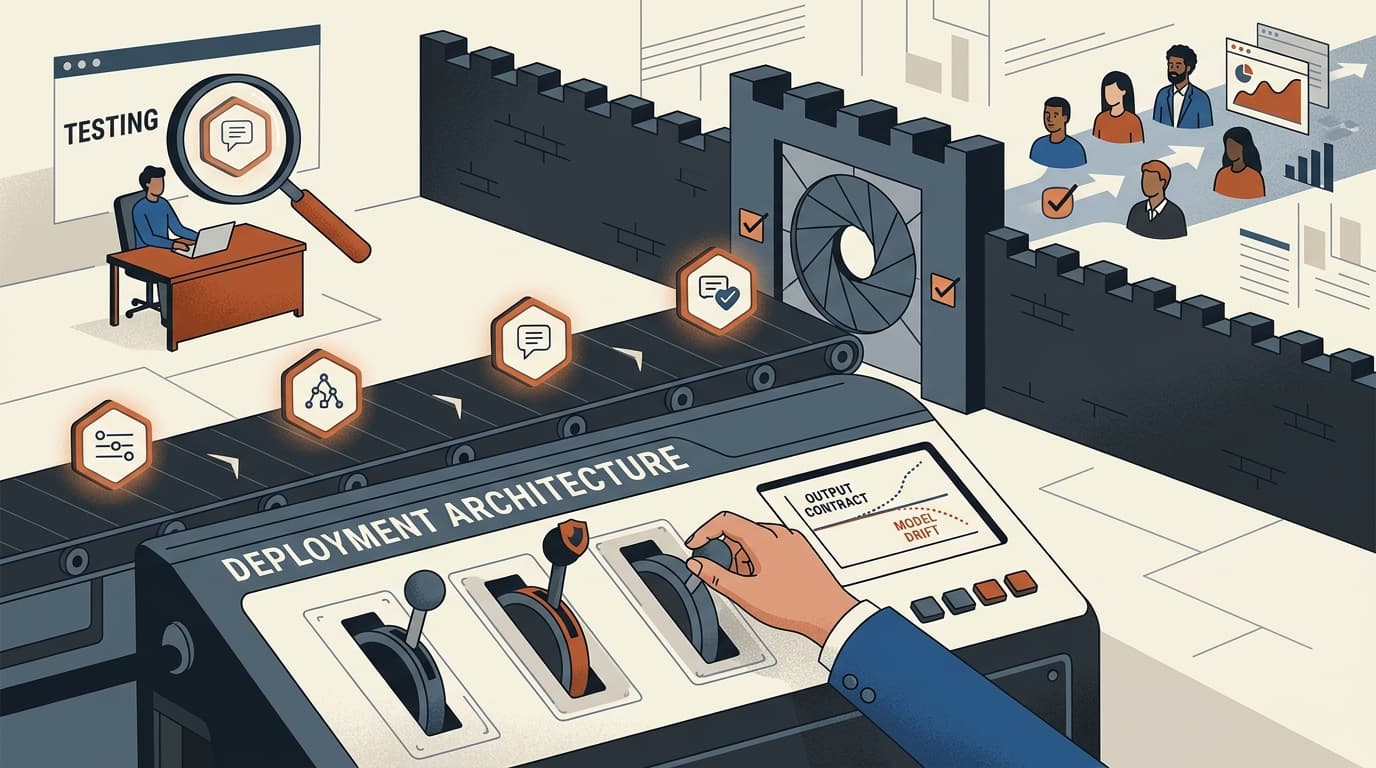

Most teams discover they have a prompt regression problem the same way: a model provider quietly ships an update, outputs start drifting, and someone notices in a support ticket three days later. By then you've got a week of degraded responses in production and no clean way to know which users were affected.
The instinct is to add more tests. That's not wrong, but it misses the structural issue: prompt regression isn't primarily a quality assurance failure. It's a deployment architecture failure. You don't have enough control over when model changes hit your production traffic, and your feedback loop from "something changed" to "we know what changed" is too slow.
Here's how teams that handle this well actually think about it.
Your Prompts Are Software. Treat Them That Way.
The framing that unlocks most of this is simple: a prompt that powers a real workflow is software. It has a contract — specific inputs, expected output shape, behavioral constraints. When the model underneath it changes, that contract may silently break.
The practical implication is that prompts need the same regression harness you'd give any other piece of production code. That means golden test cases with defined output contracts, not vibe checks. A good output contract specifies structure (return valid JSON with these keys), constraints (summary under 150 words), and behavioral rules (never recommend a competitor product). Promptfoo operationalizes this directly — you define assertions in YAML, run promptfoo eval --ci in your pipeline, and get pass/fail on every test case before anything ships.
The part teams skip: running these evals against the new model version before routing production traffic to it. If your provider updates gpt-4o in place and you're not pinning versions, your regression suite is running against yesterday's model while your users are hitting today's. That's not a test suite; it's theater.
Slow Down the Blast Radius
Even with good tests, some regressions will slip through — especially behavioral drift that's hard to encode as assertions. The answer isn't better tests alone; it's controlling how fast a model change reaches your full user base.
Langfuse's A/B testing approach is a clean pattern here: label prompt versions explicitly (prod-a, prod-b), route a fraction of traffic to the new version, and track latency, cost, and quality metrics per variant before promoting. This works whether you're testing a prompt change or a model version change — the mechanics are identical. You're doing canary deployment for your AI layer, same as you would for any other service.
The operational discipline this requires is underrated. You need to actually define what "quality" means before the experiment runs, not after you're trying to decide whether to roll back. Completion rate, user feedback signals, downstream action rates — pick your proxy metrics in advance and set thresholds. "It seems worse" is not a rollback criterion.
Detection Has to Be Faster Than Your Support Queue
The failure mode I see most often: teams have decent pre-deployment testing but almost no production monitoring on prompt behavior. So regressions that pass the test suite — subtle tone shifts, increased refusals, format drift — accumulate in production until a human notices.
Effective detection means tracking output quality signals continuously, not just error rates. Error rates catch crashes; they don't catch a model that's started hedging every answer with three paragraphs of caveats. Useful signals include conversation completion rates, downstream action rates (did the user do the thing the AI was supposed to help with?), and explicit feedback mechanisms. Cost anomalies are also a leading indicator — a model update that changes output length or reasoning behavior will show up in your token spend before it shows up in user complaints.
The rollback decision itself needs to be fast and pre-authorized. If detecting a regression takes three days and rolling back requires a deployment approval chain, you've already done the damage. The teams that handle this well have a documented rollback playbook — which model version to revert to, who can authorize it, and how to handle in-flight conversations — before they ever need it.
Eval Patterns
Golden set maintenance is the unglamorous work that actually matters. A regression suite is only as good as its test cases, and test cases go stale. Build a process for promoting real production examples — especially edge cases and failure modes — into your golden set on a regular cadence. Promptfoo's YAML format makes this low-friction; the discipline is making someone responsible for it.
LLM-as-judge assertions catch what rule-based checks miss. For behavioral contracts ("the response should be empathetic but not sycophantic"), encode the rubric as an LLM-graded assertion rather than trying to write regex for it. Promptfoo supports this natively via llm-rubric assertion types. The tradeoff: these evals cost money and add latency to your CI pipeline, so be selective about which behaviors actually need it.
Reliability Notes
Pin your model versions explicitly. Most providers offer version-pinned endpoints (e.g., gpt-4o-2024-11-20 rather than gpt-4o). Use them in production. Accept the operational overhead of intentional upgrades in exchange for not getting surprised by silent updates. When you do upgrade, treat it as a deployment event with the same controls you'd apply to a code change.
Separate your rollback levers. As this rollback guide notes, AI systems have at least three independent rollback dimensions: application code, model version, and prompt version. Know which one you're rolling back and why. Rolling back code when the problem is a model update wastes time and may not fix anything.
Cost Watch
A/B testing model versions before full rollout isn't just a quality practice — it's a cost control. A model update that increases average output length by 30% will increase your token spend proportionally, and you won't see it in your daily totals until it's already happened at scale. Running the new version on 5-10% of traffic first gives you a cost signal before you've committed the full budget. Langfuse tracks cost per prompt variant as part of its A/B testing instrumentation, which makes this comparison straightforward.
Regression test suites have a real compute cost. A golden set of 200 test cases run against two model providers on every PR adds up. Track your eval spend separately from production spend, and be deliberate about which tests run on every commit versus nightly. The goal is fast feedback on the changes most likely to regress, not exhaustive coverage on every push.


