
Six months ago I wrote that your RAG pipeline's retrieval quality is decided before the first query runs — bad chunking and bad indexing bake in failure long before anyone types a question. The follow-up problem is worse: once that pipeline is live, nothing in your standard monitoring stack tells you when retrieval quietly goes bad. The HTTP status is 200. Latency looks fine. The model answers fluently. And the answer is wrong because the retriever handed it garbage dressed up as context.
Alexander Ryan puts it bluntly: when a RAG answer is wrong, the post-mortem reflexively blames the model, someone tweaks the prompt, the ticket closes, and two weeks later the same class of wrong answer is back — because the model did its job faithfully on bad evidence, and "the component that chose the context was never on trial." A related framework circulating among RAG practitioners describes this as the gap between two different failure categories: retrieval problems and generation problems look identical from the outside, which is exactly why traditional API monitoring only catches a fraction of what can actually go wrong in a RAG system (DEV Community). Not "is our vector database up" but "is our retriever returning the right paragraph, and would we even know if it stopped."
Top-K Always Returns K, Even When Nothing Qualifies
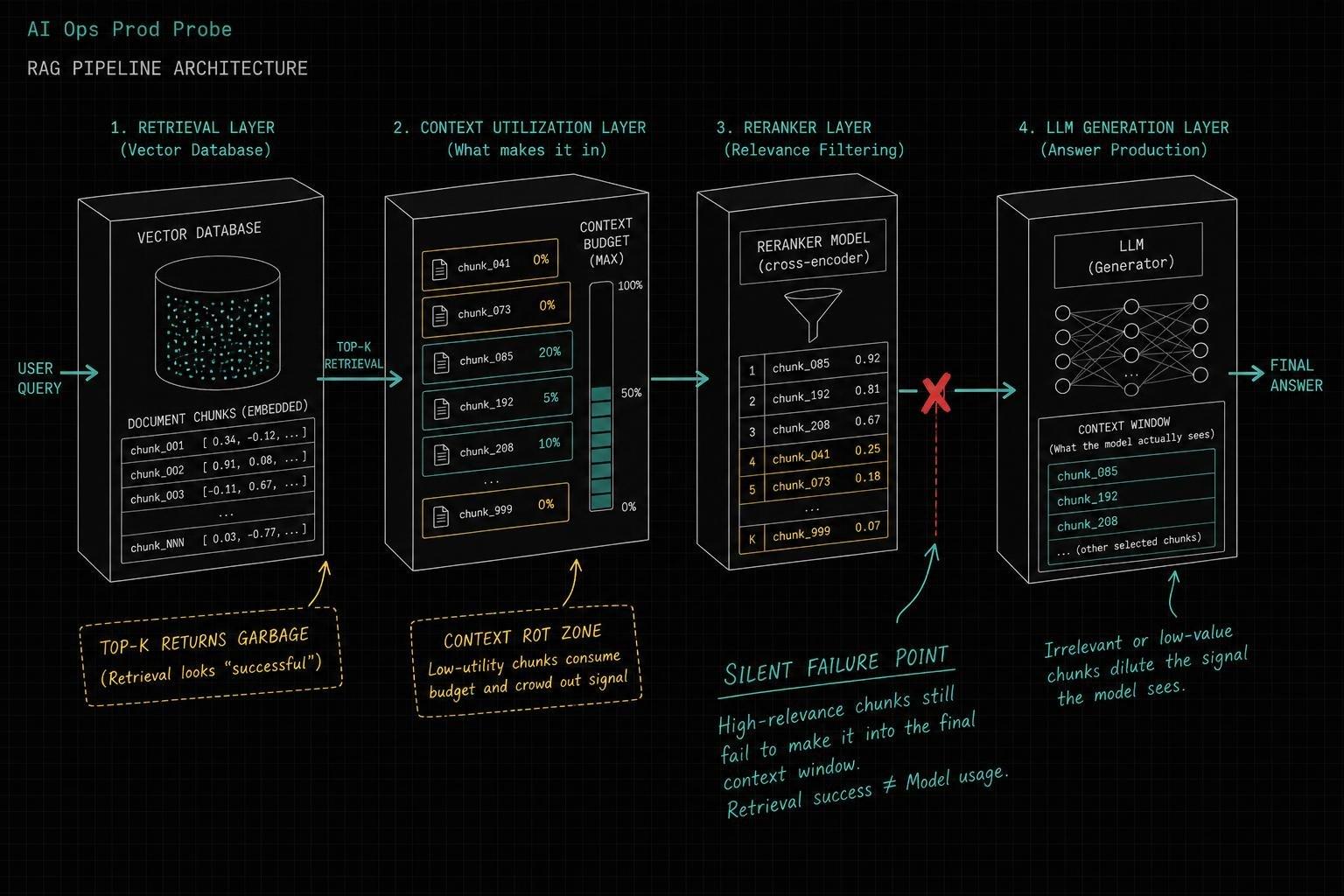
The most common retrieval failure isn't exotic. Vector search is nearest-neighbor search, and nearest doesn't mean relevant. Ask for the five closest chunks and you get five chunks whether or not any of them answer the question — and if the question isn't in the corpus at all, you still get five, now actively misleading, fed to a model instructed to trust them (Alexander Ryan). This is the quiet engine behind most RAG hallucination complaints that get blamed on the model layer.
The fix is unglamorous: a similarity-score floor below which chunks don't ship, an explicit no-answer path for queries that clear nothing, and every retrieval score logged so you can distinguish a confident match from a shrug (Alexander Ryan). If you're not logging scores today, you have no way to separate "retrieval nailed it" from "retrieval guessed," which means your eval suite is grading the model on a test it didn't actually take.
Chunk boundaries compound this invisibly, and the problem starts upstream of retrieval entirely — in how documents get parsed and split in the first place. Raw PDFs carry tables, headers, and multi-column layouts; naive parsing turns all of that into garbage chunks before a single embedding is computed (DEV Community). Even with clean parsing, when an answer straddles a chunk split, neither half embeds like the whole document did, and the correct chunk can lose a similarity contest it should win — a failure that looks fine in any single trace and only shows up in aggregate. On an 800-question benchmark, naive fixed-size chunking found the right chunk at rank one 61.1 percent of the time; structure-aware recursive splitting on the same corpus, at the same embedding cost, hit 70.8 percent (Alexander Ryan). Nearly ten points of retrieval accuracy sitting on the table, and nothing in a latency graph would ever surface it.
The Metric You're Skipping: Did the Model Even Use What You Retrieved
Retrieval can succeed and the pipeline can still fail downstream. Finding the right chunks isn't the same as the model actually using them. A four-layer monitoring model circulating among RAG practitioners this year calls this the context utilization layer: what percentage of the passed context actually shows up referenced in the final answer. The rough healthy range cited is 40 to 60 percent — lower, and you're likely dealing with noisy retrieval or badly sized chunks drowning out the signal (DEV Community).
This connects directly to a separate but related failure: context rot. Chroma's research, tested across 18 models and nearly 200,000 calls, found that accuracy degrades as context windows fill — not through a crash, but through a quiet drift where the model misses a fact it was given or follows a stale instruction over a new one (PromptsRush). Stuff a prompt with ten marginal chunks instead of three good ones to "be safe," and you may be feeding the model into exactly the zone where it stops using what you gave it. More retrieved context is not a hedge against bad retrieval. It's often the mechanism that buries the good chunk you did find. Netflix's engineering team ran into a version of this building their AI Discover feature, where they had to design explicit rules around what an LLM is allowed to surface rather than trusting the model to self-govern on raw retrieved context (Netflix TechBlog).
Traces Over Dashboards
None of this is visible in a conventional APM view, which is why tracing has become the operational backbone for RAG debugging rather than an optional add-on. A proper RAG trace captures the query rewrite, the vector search, the reranker, the prompt assembly, and the model call as one connected structure, so when an answer looks wrong you can tell whether retrieval failed, the context was ignored, or the model fabricated something on top of good evidence (MLflow). Plain logs give you timestamps. They don't show which chunks came back, in what order, with what similarity — which is precisely the data you need to catch a degraded retriever before a user does.
The same logic that's pushing product teams toward automated anomaly flagging on dashboards instead of manual review applies here: nobody is reliably eyeballing a retrieval-quality chart every morning, so the system needs to surface the regression itself rather than wait for a human to notice the line moved (Datadog). If your current RAG monitoring stops at uptime and token counts, you're watching the parts of the system least likely to tell you anything is wrong. The retriever is where production RAG actually breaks. Start logging its scores, measure whether the model even uses what it's handed, and trace the whole chain end to end — because by the time a support ticket tells you retrieval degraded, it's been degraded for a while.