


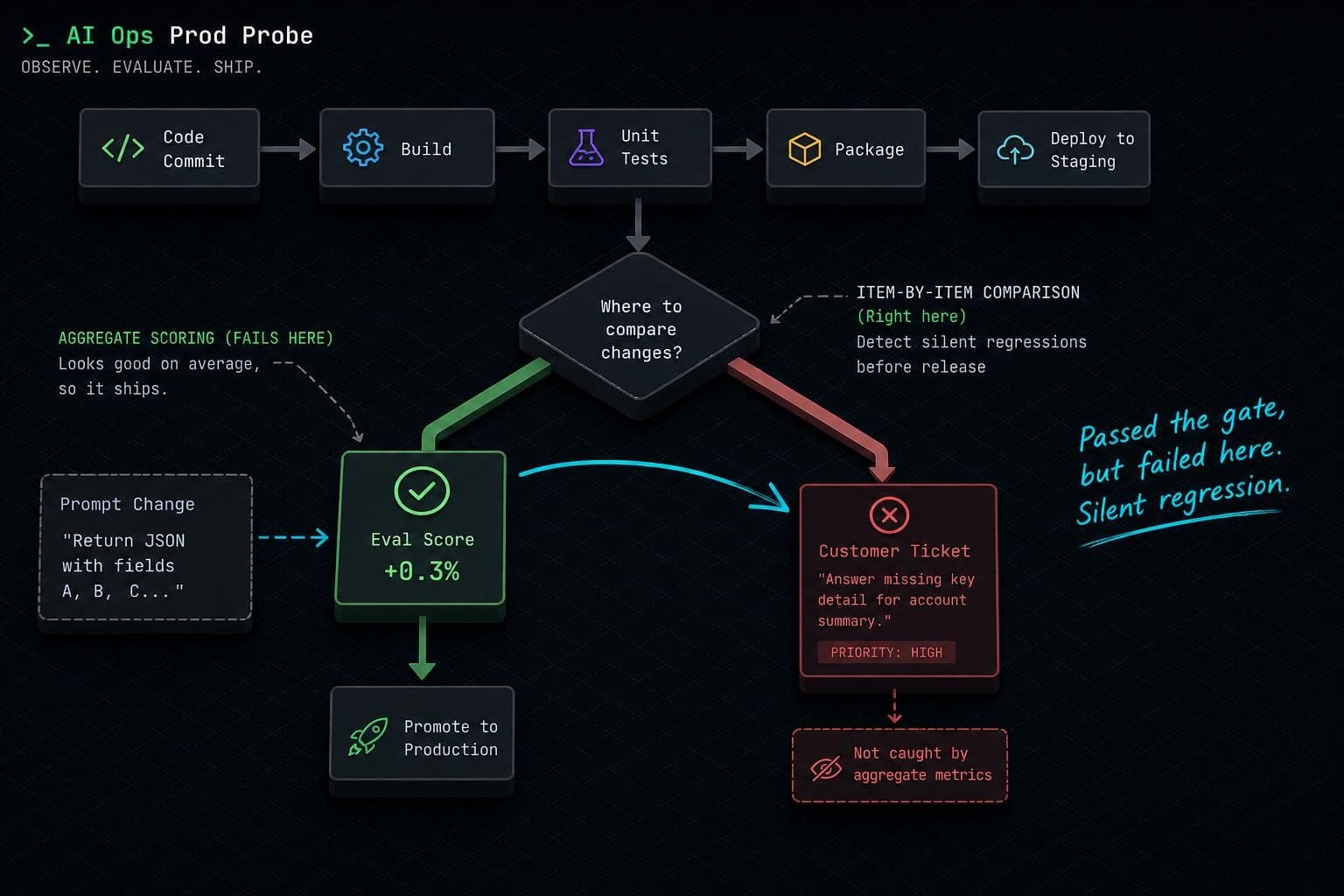

Here's the failure mode that should scare you more than an outage: your eval suite goes green, you merge the prompt change, and three weeks later a support engineer finds out your biggest customer has been getting wrong answers since the deploy. Nobody noticed because the aggregate score went up. One practitioner writing on DEV Community put it bluntly — you tweak a prompt, or the provider quietly rolls the model forward under you, and "something breaks — not loudly, not in a stack trace, just three answers that used to be right and now aren't. Nobody notices until a user does" (DEV Community).
That's the whole problem with treating prompt CI like traditional software CI. A unit test suite is deterministic — green means green. An LLM eval suite is a sample of behavior, and averaging that sample into one number hides exactly the regressions you care about most.
Stop Grading on the Curve
The instinct when you build your first prompt eval gate is to compute an accuracy score and fail the build if it drops. That's better than nothing, but it's the wrong number to watch. A prompt change can raise your average score while breaking the specific cases your biggest account depends on — a classic paradox where overall improvement masks targeted regression. The fix isn't a smarter score, it's comparing two runs item by item: which questions passed before and fail now, not just what the mean looks like (DEV Community).
Mechanically, this is simple to build. Keep your test cases as plain data — question, expected answer, and how to judge it (exact match, substring, numeric tolerance) — so the eval file is reviewable by anyone on the team, not locked inside a Python script only the ML engineer understands. Run it on every PR, exit non-zero on failure, and you've got a gate. But the artifact that actually saves you at 2am isn't the pass/fail line in your CI logs — it's the diff between the last known-good run and the candidate run, item by item.
The Matrix Test Solves a Different Problem Than the Regression Gate
Once you're comparing prompt variants against each other — not just checking a candidate against a baseline — you need something closer to a testing matrix: multiple prompts, multiple models, one gold set, run in parallel. PromptFoo's approach defines prompt variants and providers in a YAML config, runs every combination against every test case, and renders a grid where each cell shows the actual output and pass/fail against your assertions (Pristren). That's genuinely useful for the question "is Claude Haiku good enough for this prompt, or do I need the bigger model" — a cost/quality tradeoff question, not a regression-detection question.
Don't conflate the two. A model comparison matrix tells you which combination is best today, on the gold set you wrote today. It says nothing about whether tomorrow's model version silently drifted underneath a prompt that used to work. You need both: a fast regression gate on every PR, and a periodic wider matrix run when you're actually deciding on a model or prompt architecture change. Teams that only run the matrix occasionally and skip the PR-level gate find out about regressions from support tickets, not commits.
Your Gold Set Is Also a Liability, Not Just an Asset
The part everyone skips: the test cases you're gating against go stale. Hamel Husain's widely-read evals FAQ — built from teaching thousands of engineers and PMs — flags this directly as a recurring question practitioners run into: what do you do when your "gold" eval dataset becomes stale (Hamel's Blog). A CI gate built on eight-month-old test cases will happily pass a prompt that mishandles a product feature that didn't exist when you wrote the gold answers. The gate gives you false confidence precisely because it's automated — nobody's reviewing whether the questions still matter.
The discipline this demands is less glamorous than picking a tool: schedule a recurring pass where someone actually reads a sample of production traces and asks whether the gold set still reflects what users are asking. That's error analysis, not eval infrastructure, and it's the part that doesn't fit in a YAML file.
What to Watch
If you're building this now, don't start with tool selection — start with the diff-based gate on your existing eval data, since that's the thirty-minute change that catches the most damage. Add the matrix comparison when you're actually facing a model or prompt-architecture decision, not as a permanent CI step. And put "review the gold set" on a calendar, not a backlog, because nothing in your pipeline will remind you to do it. The pipeline that looks the most sophisticated on your architecture diagram is not the one that catches the regression your biggest customer feels first.