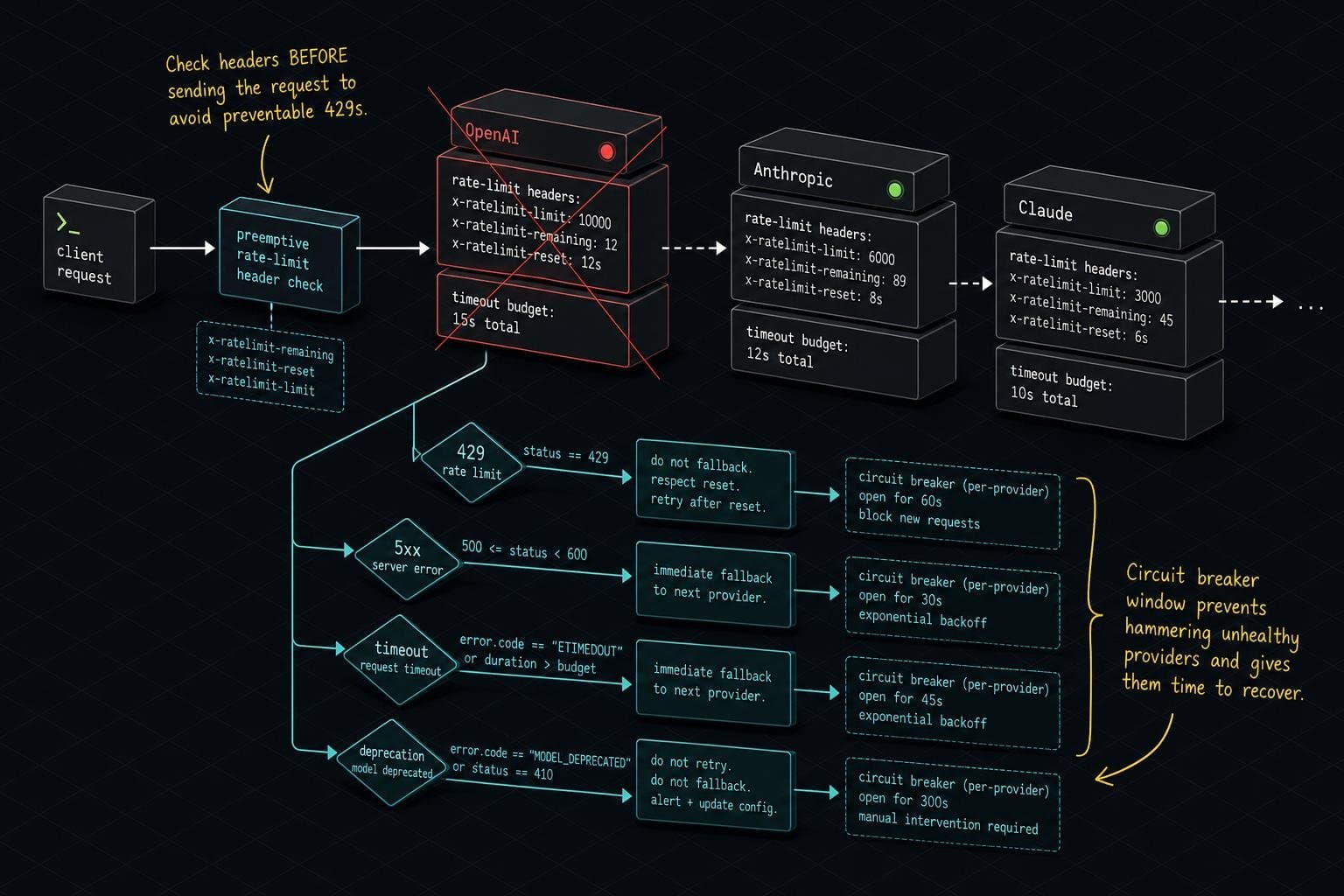

The 3am call comes in. Your AI feature is returning 500s. You check the logs, confirm it's an OpenAI outage, and feel briefly smug — you built a fallback chain six months ago. Then you watch it fail anyway.
The fallback chain wasn't wrong. It was just solving the wrong problem. You'd ordered providers by quality and wired up retry logic, but you'd never asked: which specific failure mode is this chain actually defending against? A provider outage, a rate limit spike, a model deprecation, and a timeout cascade are four different problems. They need four different responses. A single ordered list handles maybe one of them well.
This is the gap I keep seeing in production setups. Teams treat fallback as a routing problem — pick a backup, point traffic there — when it's actually a threat modeling problem.
The Failures Don't Look the Same
Inferbase's breakdown of fallback chain design makes a useful distinction that most teams skip: routing and fallback solve different problems. Routing is an optimization on the happy path. Fallback is a resilience mechanism on the failure path. The criteria differ. Routing asks "which is best?" Fallback asks "which is good enough, right now, given the first choice is gone?"
That framing matters because the failure modes have different signatures:
- Rate limits (429s) mean the provider is healthy but you've exhausted your quota. Cascading to another provider makes sense. Retrying the same one amplifies the problem.
- Provider outages (5xx) mean the endpoint is sick. You want to fail over fast and not come back until the provider has recovered — not just until one request succeeds.
- Timeouts are the sneaky one. A request that hangs for 30 seconds before failing is worse than a fast 503. Your fallback chain needs a tight timeout budget per attempt, or a slow primary will eat your entire response window before the chain even advances.
- Model deprecations are the failure nobody monitors for. A model you depend on starts returning errors on a date that was never on your calendar, as Inferbase notes. This one doesn't trip your uptime alerts. It surfaces as a slow increase in 4xx errors that looks like a client bug until someone checks the deprecation notice.
The n8n architectural guide on LLM tool calling error handling adds another layer: not all failures should even reach the fallback chain. Transport errors and transient network issues should be handled silently at the orchestration layer. Input validation failures — where the payload itself is malformed — can't be fixed by switching providers; the model needs to reason about the error and produce a corrected request. Sending a bad request to three providers in sequence doesn't make it less bad.
The Retry Storm Problem
Here's the failure mode that bites teams hardest: a provider goes degraded (not down, just slow and occasionally erroring), your retry logic kicks in, and suddenly you're sending 3-5x normal traffic to an already-struggling endpoint. The LLM waterfall pattern addresses this directly — a waterfall introduces provider failover with exponential backoff at each level, rather than hammering a sick provider with retries.
The implementation detail that matters: parse the rate limit headers before you hit the error. OpenAI returns X-RateLimit-Remaining; Anthropic uses anthropic-ratelimit-requests-remaining. If you're reading those headers, you can skip a provider before it returns a 429, rather than after. Preemptive skipping is cheaper than reactive recovery.
The waterfall pattern also suggests tracking failure counts per provider over a rolling window — something like: exclude any provider that has failed more than three times in the last five minutes. That's a lightweight circuit breaker without the full circuit breaker machinery.
What Actually Needs Observability Here
A fallback chain that fires silently is a liability. If your primary is failing over to your backup 40% of the time, you want to know that before it becomes 100%. Honeycomb's agent observability documentation frames this well: a green dashboard can hide a workflow quietly falling apart. The same applies to fallback chains — "requests are succeeding" doesn't tell you which provider is actually serving them or what the cost differential is.
The minimum instrumentation I'd want on any fallback chain:
- Which provider served each request (not just whether it succeeded)
- Fallback trigger reason — rate limit, timeout, 5xx, or deprecation
- Latency per provider, not just aggregate latency
- Token cost per provider, since your backup is often more expensive
That last one matters more than teams expect. Your fallback provider might be perfectly reliable and 40% more expensive per token. If you're silently failing over to it for hours during an incident, your bill at the end of the month will tell a story your uptime dashboard won't.
The Design Principle
Build the chain around failure modes, not provider preferences. For each failure type, decide: retry the same provider, advance the chain, or return a degraded response to the caller. Those are three different answers to three different problems, and collapsing them into a single ordered list is where most fallback implementations go wrong.
The fallback chain that saves you at 2am isn't the one with the most providers. It's the one that knows which failure it's looking at.


