


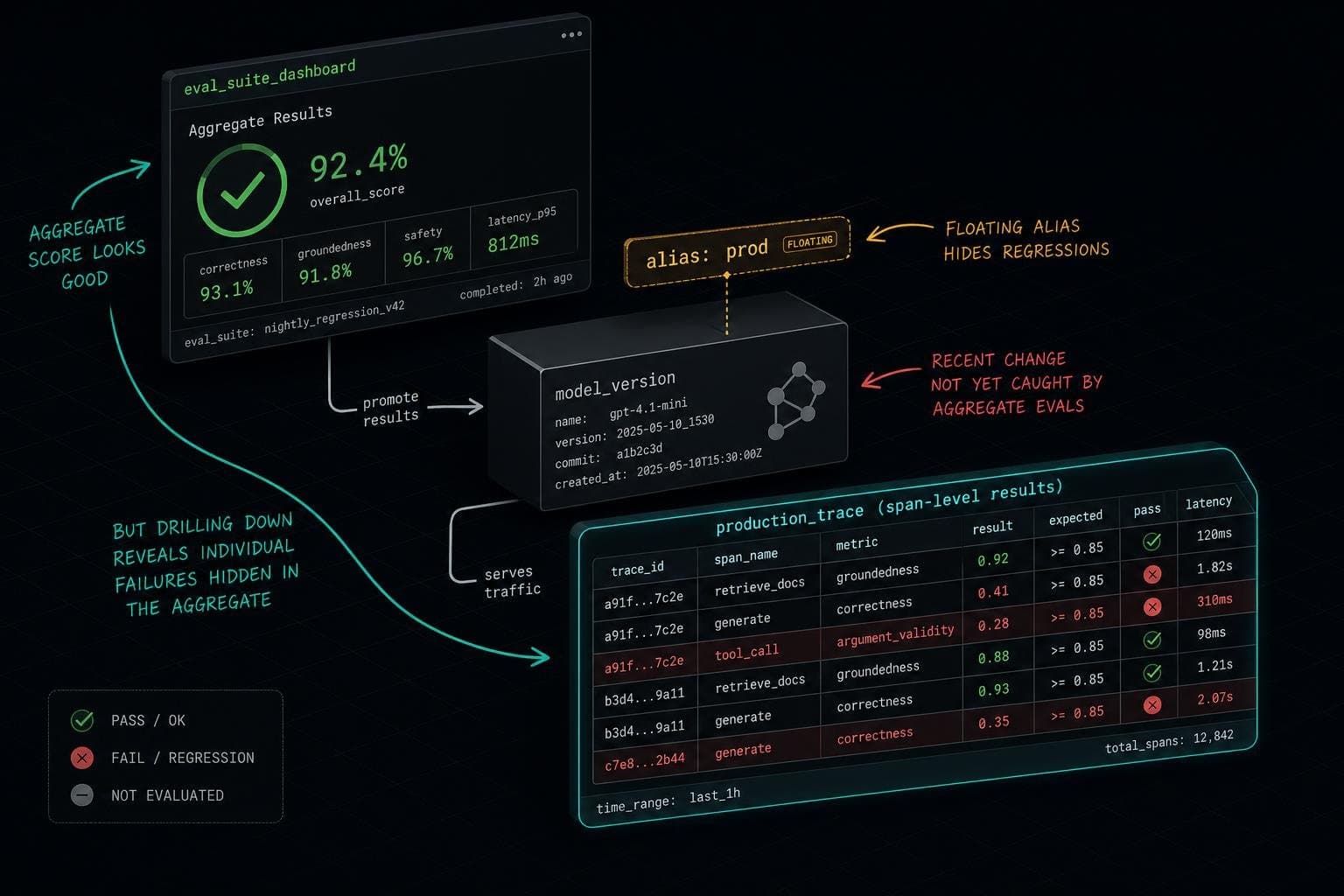

A model upgrade lands on a Tuesday. The aggregate score on the regression suite comes back a point higher than last week. The team ships it the same afternoon. By Friday, support is fielding tickets about a summarization flow that used to work fine — as TestMu AI lays out in a case that should sound uncomfortably familiar to anyone running an LLM feature behind a hosted API. The suite wasn't wrong about the average. It was answering a question nobody asked.
This is the shape of silent model drift, and it's worse than a normal production bug because nothing threw an exception. The request returned a 200. Latency looked fine. The model just started doing something subtly different than it did last month, and your provider didn't send you a memo about it.
The failure isn't the model changing — it's your instrument going stale
The instinct when you suspect drift is to write more evals. That instinct is right and also incomplete, and the reason why is worth sitting with. Arize's framing of evaluation drift draws a distinction that most teams blur: model drift is a change in the system's behavior, but evaluation drift is a change in the validity of your measurement. The system under test might not have moved an inch. What moved is the test set going stale, a judge model changing version underneath you, or a rubric that no longer matches current policy.
The reason this is the most expensive failure mode in the stack is how it presents. Normal model drift shows up as worse numbers — annoying, but actionable. Evaluation drift shows up as stable or improving numbers while the product gets worse underneath them. You get a green dashboard and angrier users, and the dashboard is exactly why nobody goes looking.
TestMu's breakdown of regression gates backs this up from a different angle: a pass-rate delta is a summary statistic, and summary statistics exist specifically to discard variation. On a regression gate, the variation you discarded is usually the thing that mattered. An upgrade can net a few points of aggregate gain while individual items flip in both directions — improvements and regressions canceling each other out inside a number that looks fine (TestMu AI). If you only report the net, you've architected your own blind spot.
What actually catches it: traces, not transcripts
The fix that keeps showing up across the better technical writing on this isn't a smarter prompt or a bigger eval set — it's treating the model as an untrusted, versioned dependency and instrumenting at the span level instead of the response level. MLflow's framing of open-source LLM observability is blunt about why: a chatbot can return a 200 in 400 milliseconds and still hallucinate a refund policy that doesn't exist. Status codes and latency numbers tell you the system ran. They tell you nothing about whether it was right. Span-level tracing, paired with evaluation built from real production traffic rather than curated hypotheticals, is what closes that gap.
Honeycomb's recent work on fleet-level AI observability makes the operational case concrete. The real question most teams can't answer isn't "is something broken" — it's "which agent is degrading right now, and is it one agent or fleet-wide," and that answer needs to come in minutes, not after a Slack thread and a half-day of manual correlation across provider consoles (Honeycomb). Honeycomb's internal tooling story on its Private Cloud team is a useful companion piece here, not because it's about LLMs directly, but because the underlying discipline — automated drift reports built by diffing configuration against a known-good baseline, continuously, rather than relying on humans to notice — is the exact posture you want applied to model behavior (Honeycomb).
Stop trusting the delta, start pinning the version
Two concrete changes separate teams that catch this early from teams that find out from a support queue. First, report improved and degraded item counts separately instead of netting them into one pass-rate number — the net is where regressions hide (TestMu AI). Second, pin and log the exact model and judge versions your eval pipeline runs against, because a model accessed through a floating alias can change behavior with zero commit in your own repo (Arize).
Neither of these is exotic engineering. They're bookkeeping. But bookkeeping is the whole game here — the labs are not going to slow down their release cadence to protect your dashboards, and the only defense that scales is building a system that assumes the floor moves and checks for it on every single call, not just at launch.