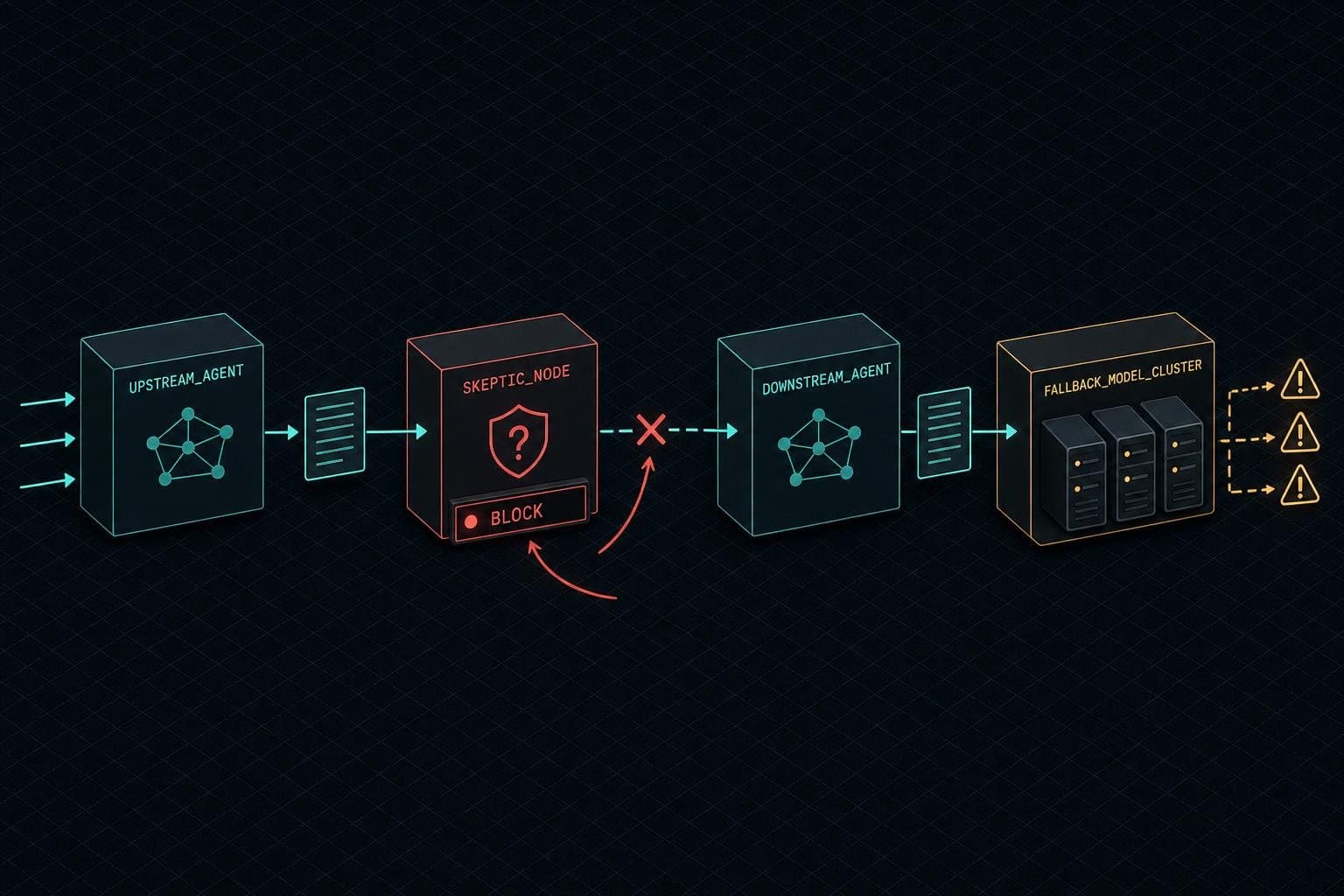

The support ticket arrives at 11am on a Tuesday. A user ran your financial summary agent overnight. The output is beautifully formatted, confidently written, and built on a company filing that doesn't exist. The researcher agent hallucinated a URL. The parser didn't complain — the fabricated content looked like valid JSON. The analyst ran calculations. The reporter wrote a compelling thesis. Every downstream agent inherited the upstream lie and amplified it.
This is what I called in the August piece on hallucination detection the "three jobs" problem: detection at generation time, detection at output time, and detection at propagation time. Most teams are only doing one. What I didn't cover is the operational architecture that actually catches propagation — and what happens when your fallback chain is the thing that breaks.
Why Prompt Engineering Is Not a Control
Before getting into architecture, let's bury one thing: "be factual" in your system prompt is not a hallucination defense. It's advisory. LLMs optimize for plausibility, not truth. When a downstream agent receives context from an upstream agent, it inherits the epistemic uncertainty of that upstream model — and typically amplifies it through sycophancy, agreeing with whatever the system prompt implies is true.
Runtime grounding verification is enforcement. The distinction matters operationally: entailment classifiers purpose-trained for synchronous enforcement run inside your perimeter, generate a structured audit log, and don't route sensitive data to a third-party API for verification. LLM-as-a-judge approaches run a second full model call per verification — which adds latency, cost, and another probabilistic system to your trust chain. In regulated environments, the audit log isn't a nice-to-have; it's what you show the security team when they ask whether you have a runtime control that blocks hallucinations before they reach downstream systems.
The practical upshot: grounding verification sits between agents in your pipeline, not at the end of it. If you're only checking outputs, you're checking after the damage is done.
The Skeptic Node Pattern
The architectural fix for hallucination propagation is inserting a validation step before any agent acts on another agent's output. The pattern is called a Skeptic Loop: a dedicated critic agent that evaluates factual grounding and logical consistency before the next stage runs. If the skeptic returns contradictions, the system loops back to the upstream agent or escalates to a human handoff — it doesn't continue.
This sounds obvious. It almost never gets built in the first version of a pipeline. The reason is that it adds latency and complexity, and in the prototype phase, your eval set is too small to show you the failure mode. Staging evals miss the long tail of production traffic; silent regressions start on day one. By the time the financial summary agent hallucinates a filing, you're already in a post-mortem.
The skeptic node is also where you need observability, not just logging. Honeycomb's framing here is useful: a real feedback loop starts from questions, not just failures. How is the agent doing at its task? Where does it struggle? What drives cost and latency? Did the last change help? If your investigation starts from a user complaint and ends with a grep through logs, you're in reaction mode. The skeptic node generates the signal; your observability layer has to be able to query it across thousands of runs, not just reconstruct a single incident.
Fallback Chains Have Their Own Failure Modes
Here's the part that trips up teams who've done the detection work but not the fallback work: every LLM API fails. Not "might fail." Fails. OpenAI returns 429s during peak hours. Anthropic has regional outages. A provider goes down for 45 minutes and your agent pipeline sits dead mid-task.
Retry logic handles transient blips. It doesn't handle provider outages, and it doesn't handle the case where your fallback model produces outputs with different grounding characteristics than your primary. Protocol incompatibility is a concrete gotcha: Anthropic's API uses the Messages protocol, not Chat Completions. Calling it through an OpenAI-shaped client produces a 404 or a garbled error. Your fallback chain needs protocol adapters, or a gateway that translates between them — otherwise you've built a fallback that fails differently than your primary, which is worse than a clean failure.
The deeper issue: your grounding verification thresholds may need to be model-specific. A faithfulness score of 0.85 on your primary model doesn't mean the same thing on your fallback. Production SLA baselines for RAG faithfulness sit at ≥0.85 with an alert threshold at 8% degradation — but those numbers were calibrated on a specific model. When you fail over, you're running a model you haven't characterized as thoroughly, under load, at 2am.
The fix is to treat your fallback chain as a separate system that needs its own eval coverage, its own grounding thresholds, and its own observability. SLO-based monitoring has proven more reliable for LLM systems than traditional metrics precisely because it surfaces behavioral drift across model changes — including the model change that happens when you fail over.
The skeptic node catches hallucinations. The fallback chain keeps the system running when providers fail. Neither works without instrumentation that can tell you, in production, whether the thing you just shipped is actually better than what it replaced.


